“In a private cloud contact center, security isn’t just a feature—it’s the foundation.”
– John McKeown, Chief Security Officer, Amazon Web Services (AWS)
Do you remember the traditional on-premises or hosted contact centers? Where customer service teams would use slow and outdated systems to resolve issues, leading to long hold times and frustration from reciting your information in front of different agents.
Fortunately, this sector evolved, and many significant changes followed.
We all can agree that private contact cloud centers have proved to be a game changer for businesses by assisting them in managing customer service operations more efficiently. However, since it is a cloud-based service, it raised security concerns as well.
According to Edge Delta: Top Cloud Security Statistics, 80% of companies have experienced at least one cloud security incident in the past year. 45% of businesses have experienced cloud-based data breaches in the past 12 months.
Such incidents made security a top priority in private cloud contact centers, and in this article, I’ll tell you everything about the security administrations in these systems. So read till the end to stay informed.
You can understand private cloud environments as a customer service solution but unlike the traditional on-premises approach, these are hosted in private cloud infrastructure.
This provides a secure, flexible, and scalable environment across multiple channels (including voice, email, chat, and social media) while ensuring a higher level of control over sensitive data. These features make it a sophisticated service solution for both businesses and customers.
Let me give you an example to give you more clarity on how it works. Imagine I want to inquire about a product online. These systems can help me resolve it by the following steps –
Throughout this process my data remains private and secure, this is how it helps companies efficiently support me while meeting privacy and compliance standards.
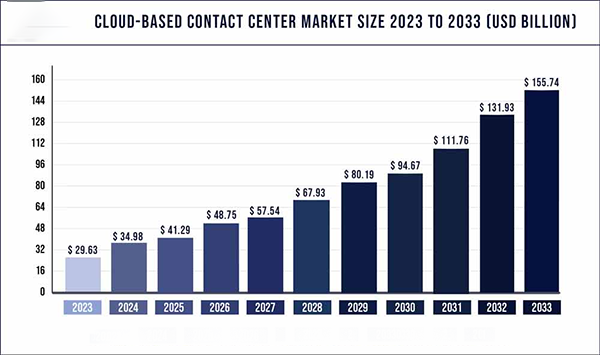
Due to the smooth, customized, omnichannel journey provided, the cloud-based contact center market is on the rise and is estimated to hit around USD 155.74 by the end of 2033 with a CAGR of 18.05% from 2024 to 2033.
Even though private cloud call centers offer enhanced security, flexibility, and control still they are not 100% protected and are exposed to certain threats, some of which are listed below –
As we know, cloud contact centers handle sensitive customer information and manage customer information across multiple channels. This puts them at higher security risks and thus calls for robust security practices. I’ve mentioned below six strategies that can help in enhancing the overall security systems –
FUN FACT
While cloud systems provide technical protection, private cloud contact centers also train agents to be human firewalls by following security best practices. Employees are trained to recognize phishing attempts and avoid risky behavior—making them the ultimate security buffer.
Like I said in the introduction from traditional on-premises centers to modern cloud contact ones, the contact center sector has evolved a lot and is continuing to do so.
This enhancement can be observed in their security controls as well. Let’s take a look at some emerging security trends that might shape the landscape of private cloud contact centers.
As we discussed in this article, security, data privacy, and legal compliance are paramount in a private cloud contact center. Over the years, control centers have significantly changed from the traditional in-premises centers to what we know today. However, due to this online shift, these systems are always at risk of cyberattacks as they handle sensitive customer data.
With the advancement of technology, it is expected that cyber threats will also evolve, making it a necessity for control centers to prioritize security and stay ahead of the curve by embracing effective security trends.
Private cloud contact centers handle sensitive customer data like personally identifiable information, healthcare records, payment, and financial details. This puts them at risk of cyber threats. Hence, security is essential for them.
A private cloud offers an infrastructure solely dedicated to one organization, this isolates their resources from other businesses and gives them more control and security over their data, minimizing the risk of cross-tenant vulnerabilities.
Security measures for private cloud contact centers help protect customer data, ensure business continuity, and comply with industry regulations. These key measures include