“Games are the most elevated form of investigation.”
— Albert Einstein
Every child loves playing games; there is no secret or hidden truth in that. The quick rewards and constant feedback in the form of levels, targets, or achievements delivered by these applications stimulate the brain to release dopamine (AKA the feel-good hormone).
This leaves a child on a hunt for more, and that is why their wish to play games is always insatiable. Most parents then complain about how their child is losing focus and is not able to study, well, this is the most expected outcome of this cycle of instant gratification that makes study feel boring or less rewarding.
But what if we integrate games into learning? Sounds like a first-grader’s dream, right? A 2022 study found that game-based learning contributes to improving social skills, empathy, and cooperation in young children (Frontiers: Game-based learning in early childhood education).
In this article, I’ll tell you how gamification in LMS can be a game changer for not just academic participants, but also for businesses. So, read till the end and discover how to implement it and make learning enjoyable for all.
I think all of us can agree that after the COVID-19 pandemic, a significant change in the education sector has been observed. Unlike the traditional ways, learning is now not limited to the four-walled rooms, more people than ever are relying on online ways of learning.
With the advancement of technology, various innovations have been introduced in the industry as well, one of which is a learning management system or LMS.
You can think of an LMS as a digital classroom. It is a software platform that acts as a centralized hub for all learning activities. By storing all the course content, resources, assignments, and feedback in one place, it facilitates management for both, the instructors and learners.
AI powered LMS is a few steps ahead of a standard LMS system, with the integration of technologies like machine learning and predictive learning algorithms to make this whole process a lot smoother. Not only that, but it also includes employee training programs that can help you master trending topics and strategies such as eCommerce technologies to remain competitive.
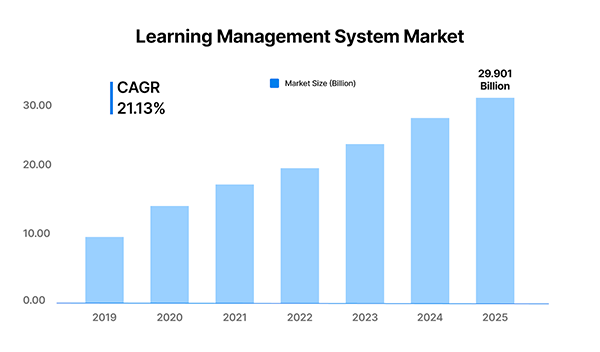
The LMS market is estimated to grow at a CAGR of 21.13% and reach USD 29.901 billion by the end of 2025.
LMS gamification is adding game-like elements to the learning operations. It is a well-known fact that children are more likely to learn and retain information they learned through more engaging and interactive methods.
This can be an effective solution for every student who thinks studying is a tedious and draining task. Interesting features like daily tasks, levels, and achievements can save children from the dull old rote learning methods and help them memorize chunks and sections more effectively.
Gamification is the trend of the current days, following the lead, Discord also introduced a new redesign bringing the fun back with gaming elements.
If you think that these advanced gamified learning management systems can only help students and professionals at school levels, then you are wrong. Nowadays, companies and businesses are also adopting this technology to help the team learn more strategic skills needed for growth and development.
Integrating gaming mechanics and principles generates excitement, satisfies people’s need to get recognized, and makes it easier to set and achieve goals. All these elements encourage everyone to participate and give their best. Let’s take a look at what can be added to these systems to make learning fun –
Once the students are done with their lessons, giving them quizzes will not only encourage them to revise what is taught in the class but, will also be able to correct themselves through the mistakes they make and retain everything better.
These quizzes can be in various forms such as true/false questions, multiple choices, or question answers. Platforms like Quizlet and Coursera excellently demonstrate this approach.
Incorporating leaderboards can motivate students to perform better and build friendly competition among them. This will push employees and students to improve themselves and move forward when they see where they stand compared to others.
When students see that they are getting points for completing certain tasks like assignments, tests, or projects, they will strive to complete their tasks on time. Instructors or teachers can use this feature to its full potential by adding a concept of weekly or monthly milestones. This will motivate the students to work harder to achieve the goals set.
Appreciating children is essential to keep them on track and make them feel valued. Receiving digital badges as a token of acknowledgment would make them feel recognized and encourage them to stay on the right track.
We know that LMS acts as a central hub for all operations, so why not use this feature to establish a clear mission and teams? This will give everyone a chance to collaborate productively, show their skills to others, and learn something from them in return. This will also foster a healthy work and learning environment that can help yield better results.
TRIVIA
The very first LMS, “CourseInfo” (later known as Blackboard), was developed in 1997 by a team led by Michael Chasen and Matthew Pittinsky at a company called Blackboard Inc.
Gamification of learning management systems can turn even the most boring topics and lessons into interesting ones. It is not only proven to be effective for students to navigate through their syllabus in a more fun and engaging way, but it is also an excellent way for businesses to train their employees and engage them to deliver the most favorable outcomes. rable outcomes.